
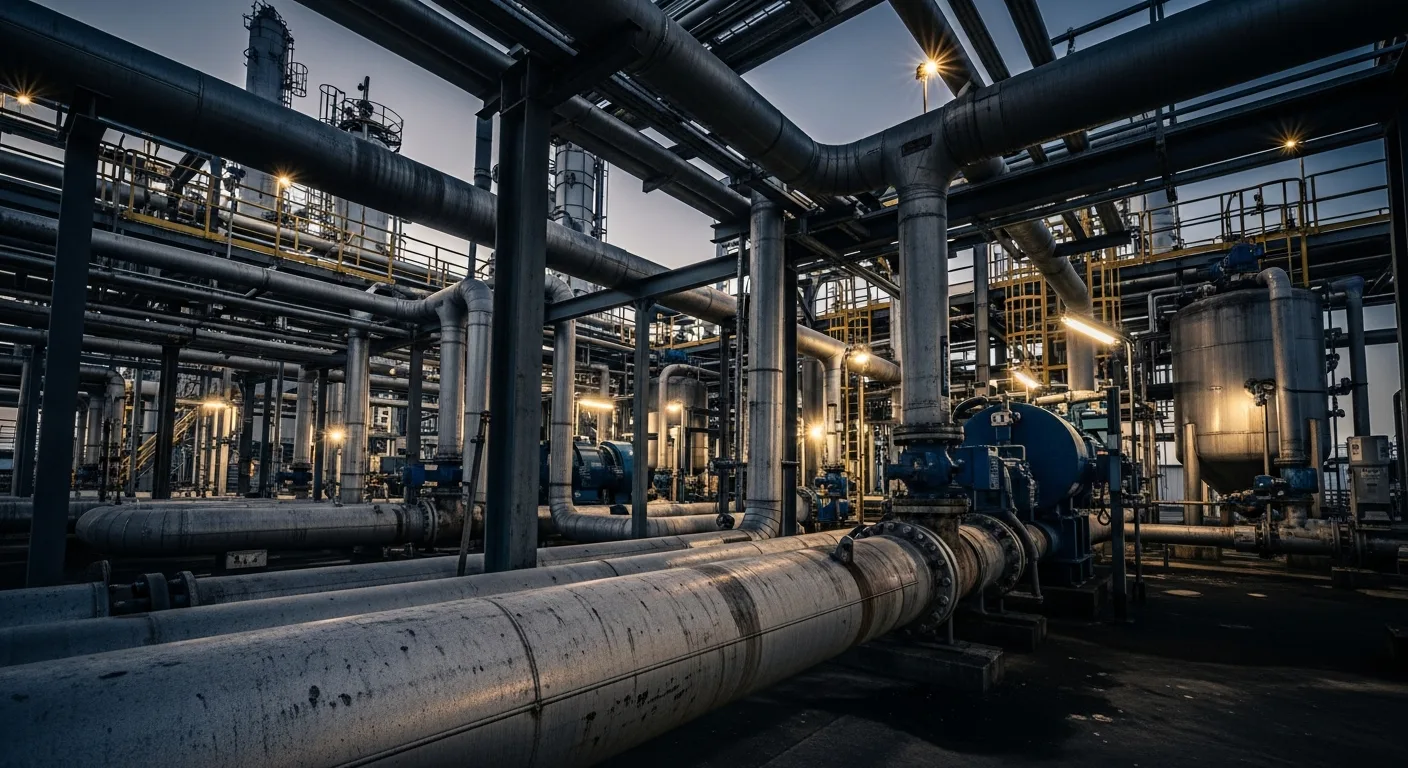
Oilfield Produced Water Treatment
Produced water volumes keep climbing. Treatment standards tighten regardless.
CDFU-based produced water treatment removes emulsified oil and suspended solids in 1–5 minutes — no chemical coagulants, no oily hazardous sludge, no coalescing media to blind. Proven across onshore and offshore oilfields from China to West Africa.
Why conventional oilfield treatment fails.
Produced water treatment is governed by reservoir fines migration risk, surface discharge regulations, and reinjection standards — and the tolerance for failure is zero.
Rising water cuts, more emulsified oil
As oilfields mature, produced water volumes climb while oil-water density differences shrink. Emulsified oil droplets — too small for gravity separators and conventional CFUs — remain in the water phase and violate reinjection quality targets.
Chemical coagulants generate hazardous sludge
Conventional DAF and CFU systems dose coagulants and flocculants to break emulsions. The result is oily chemical sludge classified as hazardous waste — a disposal cost that conventional OPEX models typically ignore.
Polymers blind conventional filters
Fracturing flowback fluids carry high-molecular-weight polymers that clog conventional coalescing plates and destabilise DAF cells. HPAM polymer concentrations above 200 mg/L make most legacy systems inoperable within weeks.
Remote and offshore sites demand compact systems
Offshore platforms and remote field sites have hard limits on deck space, weight, and operator headcount. Conventional dissolved air flotation tanks occupy three times the footprint of a skid-mounted CDFU at equivalent throughput.
Three treatment trains for every oilfield scenario.
The right train depends on the produced water composition, oil emulsification grade, and target effluent quality. All trains are chemical-free.
Conventional produced water at high-perm fields; OIW primarily dispersed and emulsified; injection or surface discharge required.
Two-stage CDFU achieves OIW <30 mg/L and SS <30 mg/L. SFM polishes to median particle <3 µm for high-perm reservoir injection.
A2 low-permeability injection standards (OIW ≤6 mg/L, SS ≤2 mg/L, median particle ≤1.5 µm). Standard single SFM stage insufficient.
Dual-stage SFM polishing after 2-stage CDFU meets A2 low-permeability injection standards. Floating oil recovered at each CDFU stage.
Polymer-flooding produced water or high-COD fracturing flowback where HPAM polymer and organic load must also be removed. Applies to ultra-tight A1 reservoirs.
N₂-driven CDFU avoids dissolved O₂ fouling; CDOF destroys HPAM polymer and refractory COD via catalytic ozonation before final SFM filtration.
Purpose-built for oilfield water chemistry.
 CDFU
CDFUCDFU — Cyclonic Dissolved-Gas Flotation
Physical cyclonic flotation removes emulsified and dispersed oil down to 2 µm in 1–5 minutes. No chemicals. No oily sludge. Compact skid for offshore and remote field deployment.
Full technical specifications KHC
KHCKHC — High-Efficiency Coalescer
Four-in-one coalescing separator achieves 0.1 µm demulsification. Applied downstream of CDFU when polymer flooding or density-near-parity emulsions require sub-1 mg/L oil targets.
Full technical specifications SFM
SFMSFM — Surface-Modified Filtration Media
Negatively-charged silicate media filter achieves ~1 µm precision — oil ≤6 mg/L, SS ≤2 mg/L. Automatic hydraulic backwash. 15-year media life. Zero chemical addition.
Full technical specifications CDOF
CDOFCDOF — Cyclonic Dissolved Ozone Flotation
Catalytic ozonation removes COD, color, and refractory organics in fracturing flowback fluids where organic load cannot be addressed by physical separation alone.
Full technical specificationsOilfield case record.
All cases drawn from verified project documentation. Client, location, configuration, capacity and commissioning year are recorded facts.
| Client | Location | Application | Configuration | Capacity | Year |
|---|---|---|---|---|---|
| National Oil Corporation | Xinjiang Oilfield, China | Fracturing flowback water | CDFU + KFM | 360 m³/d | 2016 |
| National Offshore Oil Corp. | Weizhou Field, China | Produced water treatment | CDFU | 900 m³/d | 2017 |
| Regional Petroleum Company | Shaanxi, China | Oilfield produced water | CDFU + KFM | 240 m³/d/set | 2017 |
| National Oil Corporation | Changqing Oilfield, China | Produced water & reinjection | CDFU + KFM | 350 m³/d/set (1,400 m³/d total) | 2017 |
| National Offshore Oil Corp. | Bohai Sea, China | Polymer-containing flowback | KHC + CDFU | 480 m³/d | 2018 |
| Regional Oilfield Operator | Xinjiang, China | Produced water treatment | 2-stage CDFU | 2,400 m³/d | 2018 |
| National Oil Corporation | Huabei Oilfield, China | Produced water treatment | CDFU + KFM | 300 m³/d/set | 2019 |
| Independent Oilfield Operator, Phase I | Congo, West Africa | Produced water & fracturing flowback | CDFU + CDOF + KFM | 4,600 m³/d | 2023 |
| National Offshore Oil Corp. | Suizhong Terminal, China | Produced water treatment | 2-stage CDFU | 360 m³/d | 2023 |
| National Oil Corporation | Xinjiang Jundong, China | Produced water treatment | CDFU + KFM | 1,000 m³/d | 2023 |
| Independent Oilfield Operator, Phase II | Congo, West Africa | Produced water & fracturing flowback | CDFU + CDOF + KFM | 6,500 m³/d | 2025 |
Questions from procurement and engineering teams.
Yes. CDFU uses pure-physical cyclonic flotation with no internal media or coalescing plates, so high-molecular-weight HPAM polymer does not clog the unit. Proven at PetroChina Changqing and Xinjiang oilfields on polymer-flooding produced water with initial OIW around 1,500 mg/L reduced to ≤86 mg/L in a single CDFU stage.
Conventional CFU (induced gas flotation) requires chemical coagulants, generates oily sludge, and is only effective on free/dispersed oil (≥30 µm). Conventional DAF is effective on dispersed oil but uses 15–40 min retention time, large open tanks, and also requires coagulant dosing. CDFU achieves >90% oil removal — including emulsified oil down to 2 µm — in 1–5 minutes, fully chemical-free and in a closed pressure vessel roughly one-third the footprint of equivalent DAF.
Yes. CDFU is supplied as a skid-mounted, closed pressure vessel with a footprint approximately one-third of conventional DAF at the same throughput. Units are modular up to 500 m³/h each. The system has been installed on CNOOC's Bohai Sea offshore central platform and on remote African oilfield locations (Congo, West Africa). Fully enclosed operation meets offshore HSE gas-venting requirements.
No. CDFU removes oil through pure physical cyclonic flotation — no chemical coagulants or flocculants are dosed at any stage. The separated oil exits as recovered oil suitable for re-processing. There is no chemical oily sludge — eliminating the hazardous-waste disposal cost that is a major hidden expense of chemical-based treatment.
Yes. CDFU is designed with no internal media beds or coalescing elements that can be fouled or blinded by concentration spikes. The system tolerates oil-in-water inlet concentrations from tens of mg/L up to 2,000 mg/L within the same unit, handling the shock loads that occur during field startup, workover operations, and composition changes from diversified crude sources.
Tell us your produced water challenge.
Inlet composition, reinjection target, flow rate, site constraints — send us the specs and we will size the right treatment train.