
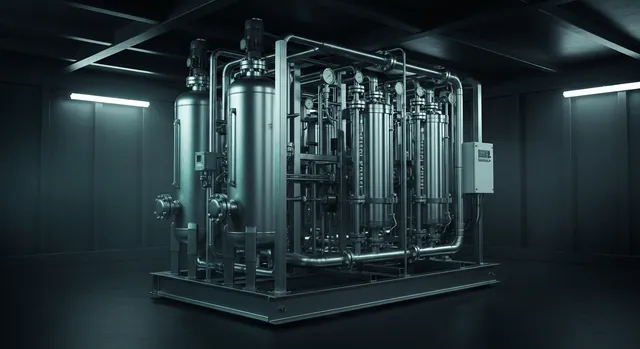
The next-generation compact flotation unit for oily wastewater treatment. Pure-physical, chemical-free oil removal — dissolved gas flotation redefined.
KELIER's patented CDFU integrates cyclonic centrifugal separation with dissolved gas flotation (DGF) and 5–30 µm microbubble technology to achieve single-stage oil-in-water removal exceeding 90% — without chemical demulsifiers or flocculants. Designed as a compact flotation unit (CFU) replacement, CDFU delivers effluent oil content below 5 mg/L in under five minutes' retention time, making it the benchmark choice for offshore produced water treatment, oilfield produced water reinjection and refinery electric-desalting wastewater.
Benchmark-setting numbers.
* Single CDFU unit effluent oil ≤30 mg/L. A downstream filter is required to achieve <5 mg/L.
Dissolved-Gas Flotation, Reinvented
Dissolved gas flotation (DGF) works by dissolving gas into water under pressure, then releasing it as a cloud of micro-bubbles that attach to oil droplets and lift them to the surface. Conventional compact flotation units (CFUs) achieve fast separation but depend on chemical demulsifiers that drive up OPEX, generate oily hazardous sludge, and cause clogging in high-salinity produced water.
CDFU replaces that chemistry with physics. Oily produced water enters the flotation tank tangentially — forming an instant cyclonic flow field. The cyclonic centrifugal force rapidly separates heavy suspended solids, while 5–30 µm dissolved-gas microbubbles adsorb onto emulsified oil droplets as small as 2 µm and float them to the collection cylinder. Result: >90% free-oil and emulsified-oil removal in 1–5 minutes, zero chemicals, zero oily sludge.

Cyclonic Flotation Tank + Stabilization Tank + Cyclonic Dissolved Gas Pump — the three-unit closed-loop system that delivers chemical-free produced water treatment.
How CDFU Works
CDFU operates as a continuous, pressurized, chemical-free flotation process. Four tightly integrated stages — from cyclonic microbubble generation through oil collection — eliminate the need for open tanks, skimmer arms or chemical dosing.

The bi-tangential inlet creates a stable cyclonic flow field. Microbubbles spiral inward, concentrating bubble–oil aggregates at the central cylinder for continuous oil discharge — no moving parts, no open-tank exposure.
CDFU's cyclonic dissolved-gas pump generates uniform microbubbles 5–30 µm in diameter — roughly 1/3 the size of conventional CFU bubbles. At this scale, the bubble-oil interfacial energy (ΔE = σLG(1 − cosθ)) is sufficient to adsorb and lift emulsified oil droplets as small as 2 µm, which conventional IGF cannot reach.

Pressurized inlet & microbubble generation
Oily produced water is mixed with dissolved-gas water (produced by the cyclonic dissolved-gas pump). The mixture enters the flotation tank tangentially through the bi-tangential inlet design, immediately generating a stable cyclonic flow field.
Cyclonic centrifugal degritting
The conical bottom zone uses centrifugal force to fling heavy particles and solids outward and downward, preventing grit accumulation — the CDFU's patented cyclonic degritting feature that removes solids without any filter internals to clog.
Microbubble–oil adhesion & flotation
In the inner and outer flotation zones, 5–30 µm microbubbles collide and adhere to dispersed and emulsified oil droplets. Cyclonic flow concentrates bubble-oil aggregates in the central cylinder. Interfacial energy reduction drives stable adhesion — oil and bubbles rise as floating oil.
Separation & effluent discharge
Floating oil rises into the inner oil collection cylinder and exits via the pressure oil outlet. Clean treated water exits from the bottom drain port. A fraction is recycled to the dissolved-gas pump to regenerate microbubble-saturated water — closing the loop with no external chemical addition.
Physics,
Not Chemistry.
Zero chemicals · Zero sludge · Zero compromise
CDFU harnesses cyclonic centrifugal force and 5–30 µm dissolved-gas microbubbles to lift emulsified oil droplets as fine as 2 µm — no chemical demulsifiers, no flocculants, no oily sludge. The result: >90% oil-in-water removal in under five minutes, across produced water flows from 100 to 30,000 m³/day.
Six Reasons CDFU Outperforms
Chemical-Free Demulsification
Emulsified Oil Removal to 2 µm
1–5 min Retention Time
Compact Skid-Mounted Unit
Robust Shock-Load Resistance
IoT / AI Intelligent Operation
CDFU vs DGF vs IGF vs DAF
Where CDFU Delivers

Offshore Produced Water Treatment
Floating platforms (CEP, FPSO) generate produced water at rates that exceed space budgets. CDFU's skid-mounted, 1/3-footprint design and closed pressurized operation makes it the compact flotation unit of choice for offshore OIW removal.
Oilfield solutions
Produced Water Reinjection (PWRI)
Meeting reinjection quality targets (OIW <5–20 mg/L, SS <5 mg/L, median particle ≤2 µm) requires consistent emulsified oil removal at scale. CDFU+SFM filter trains have delivered proven reinjection-grade water across Xinjiang, Changqing, Huabei and Congo oilfields.
Oilfield solutions
Oilfield Fracturing Flowback Fluid
High polymer, high OIW, highly variable flow — exactly the conditions where chemical-based CFUs fail. CDFU's chemical-free, shock-load-resistant process has been proven on Xinjiang polymer flooding produced water (OIW 1,500 ppm → 86 ppm, single stage).

Refinery Electric-Desalting Wastewater
OIW concentrations of 500–30,000 mg/L from crude-oil electric desalters. Proven at PetroChina Dushanzi, Changqing Petrochemical, Sinopec Cangzhou and Urumqi — two-stage CDFU achieving OIW <10 mg/L at 2,400 m³/d.
Refinery solutions
Refinery Oily Wastewater — API/CPI Pre-treatment
Replaces or upgrades legacy API separators and CPI packs in brownfield refineries. Chemical-free process avoids chemical-sludge complications during API-CPI-DAF chain upgrades.
Proven Treatment Train
The standard CDFU treatment train for oily wastewater treatment: three-phase separator → oil-water separator → Stage 1 CDFU → Stage 2 CDFU → SFM Filter → Treated Water Outlet → Reinjection / Discharge.





* Single CDFU unit outlet ≤30 mg/L; downstream SFM filter required for <5 mg/L.
Field-Verified Performance
PetroChina Dushanzi Petrochemical — Electric Desalting
CNPC Changqing Oilfield — Produced Water Reinjection
CNOOC Huizhou Refinery — Oily Sludge Wash Water
Common Questions About Dissolved-Gas Flotation
Cyclonic Dissolved-Gas Flotation Unit (CDFU) is a compact flotation unit that combines dissolved-gas microbubbles (5–30 µm) with a cyclonic centrifugal flow field inside a pressure vessel. The cyclonic motion dramatically shortens retention time and enhances bubble–oil adhesion, achieving >90% oil-in-water removal in 1–5 minutes — without chemical additives.
DAF (dissolved air flotation) uses air dissolved under pressure — effective but slow (15–40 min) and open-tank. IGF (induced gas flotation) injects gas mechanically — fast but large-bubble (>50 µm), ineffective on emulsified oil, chemical-dependent. DGF (dissolved gas flotation) is the broader category covering dissolved-gas methods (including CDFU). CDFU is the patented cyclonic DGF variant: closed, chemical-free, 5–30 µm microbubbles, 1–5 min HRT — combining the compactness of IGF with the emulsified-oil performance of dissolved-gas technology.
Dissolved gas is released as a cloud of micro-bubbles at pressures slightly above atmospheric. These bubbles adsorb onto hydrophobic oil droplets (contact angle θ > 90°), reducing interfacial energy. The bubble-oil aggregate has a density lower than water and rises rapidly. In CDFU the cyclonic flow field concentrates the rising aggregates in the central cylinder, from which they are discharged under pressure — no skimmer arm, no open tank.
Yes. Conventional IGF/CFU units can only remove free and dispersed oil (droplets ≥30–100 µm). CDFU's 5–30 µm uniform microbubbles target emulsified oil droplets down to 2 µm through physical demulsification — without the chemical demulsifiers that generate oily hazardous sludge.
CDFU is a fully chemical-free process. No coagulants, flocculants or demulsifiers are added at any stage. This eliminates reagent cost, chemical-storage regulations and oily-sludge hazardous-waste disposal — a critical differentiator versus SLB and Veolia CFU systems which require specialist chemicals.
Conventional dissolved air flotation requires 15–40 minutes. CDFU achieves the same or better oil removal in 1–5 minutes — 3–8× faster — because the cyclonic flow field creates a high collision probability between microbubbles and oil droplets without long quiescent settling.
Yes. Refinery oily wastewater — including electric-desalting (desalter) effluent — contains a challenging mix of free oil, finely emulsified oil, suspended solids, and demulsifier carry-over that defeats conventional IGF/CFU units. CDFU's 5–30 µm microbubbles are sized to target these fine emulsified droplets, and its chemical-free operation avoids the sludge penalty that plagues coagulant-based DAF systems in refinery service. It is suitable as a primary separator ahead of biological treatment or as a polishing stage before discharge, and can be skid-mounted inside existing refinery battery limits.
Yes — CDFU is supplied as a skid-mounted pressure-vessel system in modular configurations up to 500 m³/h per unit. Its footprint is ≈1/3 of conventional DAF, it operates fully enclosed (no gas venting to atmosphere), and it has been successfully deployed on CNOOC's Bohai Sea offshore platform. It meets the space, weight and HSE constraints of offshore and FPSO installations.
What comes next?
Need reinjection-grade polishing?
CDFU removes dispersed oil — SFM strips the residual particles down to ≤ 1 µm for safe reinjection. Specify both for a complete produced-water train.
Ready to Specify CDFU for Your Project?
Our engineers can size a CDFU system for your flow rate, inlet OIW and outlet target — typically within 48 hours.