
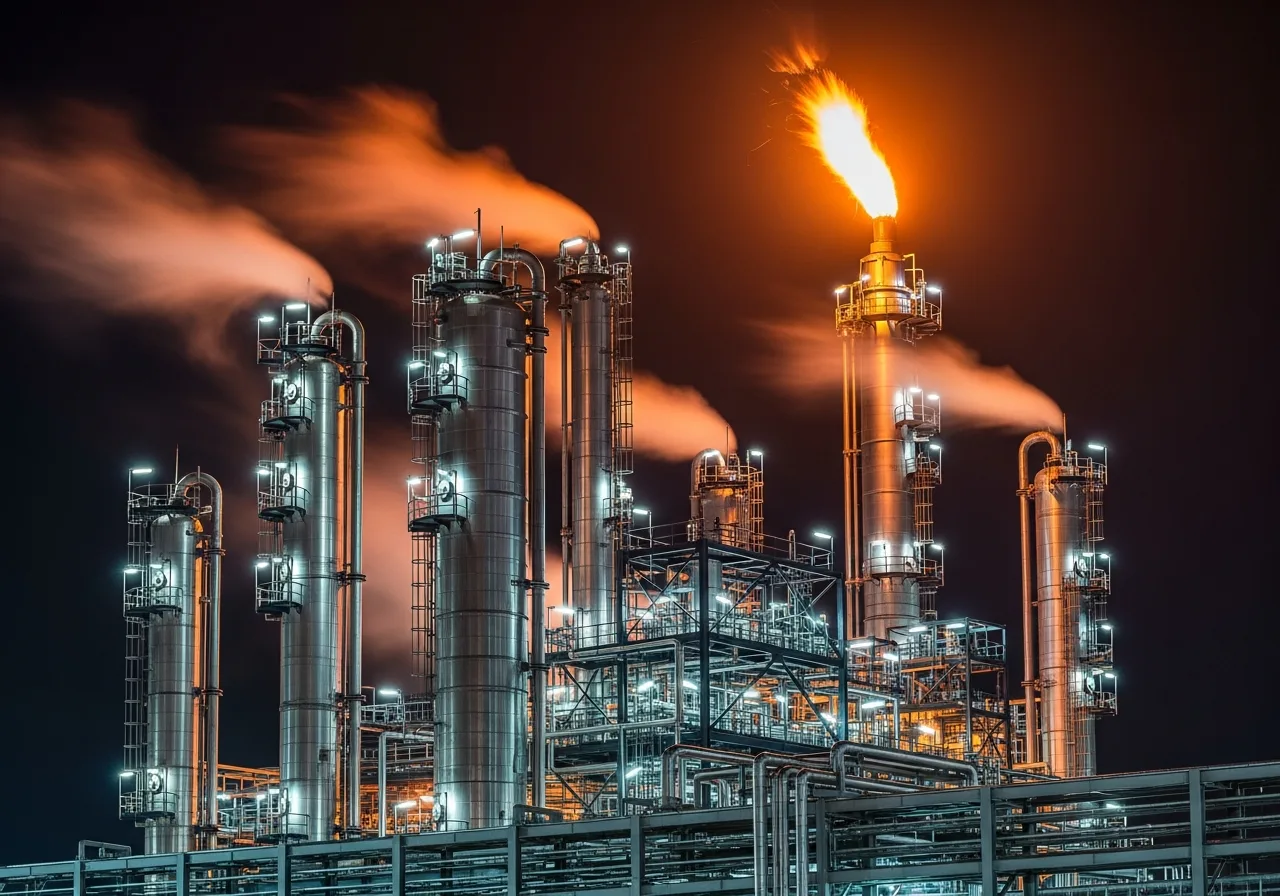
Refinery Wastewater Treatment
Refinery effluents don't fit one standard. The treatment system has to.
CDFU and KHC-based treatment for the full range of refinery oily effluents — from desalting blowdown and coker sour water to crude tank washings and cooling water deoiling. No chemical coagulants. No hazardous oily sludge.
Why refinery wastewater defeats standard approaches.
Refinery wastewater is not a single stream. Each unit operation produces a different effluent — and the treatment strategy must match the chemistry, not the plant average.
Desalting blowdown: up to 20% oil in dense emulsion
Electric-desalter blowdown (crude-unit effluent) carries oil at concentrations from hundreds to 200,000 mg/L — forming dense emulsions where oil and water density are nearly equal. Gravity separation, hydrocyclones, and chemical coagulants all fail to meet pre-treatment targets reliably.
Crude composition changes invalidate dosing formulas
Refineries processing diversified crude slates — including sour, heavy, and waxy blends — constantly shift wastewater chemistry. No single chemical dosing formula remains effective as crude source changes. The result is sporadic permit violations and reactive OPEX.
Coker sour water carries oil and COD simultaneously
Coker sour water (coking unit effluent) contains emulsified oil, high-boiling phenols, sulfides, and VOCs in combination. Conventional treatment either fails on oil or fails on COD — neither a DAF unit nor a biological reactor can handle both simultaneously.
Chemical coagulants convert oil into hazardous oily sludge
Chemical coagulants convert separated oil into heavy oily sludge that must be classified, transported, and disposed of as hazardous waste. The disposal cost is typically excluded from published treatment OPEX comparisons — making conventional systems appear less expensive than they are in practice.
Four effluent streams. Four treatment approaches.
The technology modules are the same across all scenarios. The sequence and configuration differ based on stream chemistry and target effluent quality.
 Desalting wastewater (electric-desalter blowdown)
Challenge: Oil 500 mg/L to 200,000 mg/L in stable nanoemulsion; density near-parity; standard gravity and coagulant-DAF systems fail to reach pre-treatment targets.
High-efficiency pressure coalescing oil remover physically breaks the dense nanoemulsion; CDFU flotation achieves effluent oil <100 mg/L. Side streams: waste oil to crude unit; backwash water recycled.
 Coker sour water (highly emulsified)
Challenge: Sour water from coking unit carries emulsified oil together with H₂S, ammonia, and suspended solids. Coarse pre-filtration is required before flotation to protect unit internals.
N₂ or methane replaces air to avoid dissolved-oxygen interference; dual coarse/fine filters bracket the CDFU; KHC polishes residual emulsified oil to <15 ppm before stripping. Light waste oil and backwash water recycled.
 CDU / VDU sour water (distillation column overhead)
Challenge: Sour water from atmospheric and vacuum distillation column overhead contains emulsified light oil, H₂S, and ammonia. Low oil concentration but high emulsification stability.
Coalescing pressure separator removes free light oil first; multiphase cyclone filter handles both liquid and solids; KHC delivers <15 ppm OIW before stripping. Waste oil to waste oil tank.
Challenge: Biochemical effluent and backwash water still carry residual COD, color, and trace organics that prevent direct discharge. Conventional biological treatment cannot reach Class III surface-water standards.
CDFU removes residual suspended matter and oil before ozone contact; CDOF catalytic ozonation destroys COD, color, and trace organics; tail gas destruction eliminates ozone off-gas. Effluent meets discharge or DTRO recycle quality.
Matched to refinery water chemistry.
CDFU — Cyclonic Dissolved-Gas Flotation
Physical cyclonic flotation removes dispersed and emulsified oil up to 2,000 mg/L inlet in 1–5 minutes. No chemical coagulants. No oily sludge. Proven at PetroChina, Sinopec, and CNOOC refineries across China.
Full technical specificationsKHC — High-Efficiency Coalescer
Physically splits dense nanoemulsions that resist CDFU alone. Applied upstream of CDFU for desalting blowdown where oil-water density near-parity creates very stable emulsions. Oil removal >95%, no chemicals.
Full technical specificationsCDOF — Cyclonic Dissolved Ozone Flotation
Destroys refractory organics, phenols, sulfides, and COD via catalytic ozonation at pH 3–10. COD removal >85%. Applied downstream of CDFU for streams where organic load must also be reduced.
Full technical specifications SFM
SFMSFM — Surface-Modified Filtration Media
~1 µm filtration precision removes residual emulsified oil and fine suspended solids to effluent oil ≤6 ppm, SS ≤2 mg/L. Automatic self-cleaning backwash. No chemical addition. 15-year media life.
Full technical specificationsRefinery case record.
All cases drawn from verified project documentation. Client, location, configuration, capacity and commissioning year are recorded facts.
| Client | Location | Application | Configuration | Capacity | Year |
|---|---|---|---|---|---|
| National Offshore Oil Corp. | Huizhou Refinery, China | Oily sludge wash water | KHC + CDFU | 720 m³/d | 2018 |
| National Oil Corporation | Dushanzi Petrochemical, China | Desalting wastewater | 2-stage CDFU | 2,400 m³/d | 2019 |
| National Refining Corp. | Luzhou Branch, China | Desalting wastewater | KHC + CDFU | 1,200 m³/d | 2020 |
| National Oil Corporation | Sichuan Petrochemical, China | Desalting wastewater | KHC + CDFU | 1,700 m³/d | 2020 |
| National Oil Corporation | Urumqi Petrochemical, China | Desalting wastewater | CDFU | 2,400 m³/d | 2021 |
| National Refining Corp. | Luoyang Petrochemical, China | Coker sour water | KHC + CDFU | 360 m³/d | 2021 |
| National Oil Corporation | Jinxi Petrochemical, China | Desalting wastewater | KHC + CDFU | 1,200 m³/d | 2022 |
| Regional Petrochemical | Ningbo, China | Desalting wastewater | KHC + CDFU | 900 m³/d | 2022 |
| National Oil Company Refinery | Chad, Africa | Coking sour water | KHC | 480 m³/d | 2022 |
| State Refinery | Uzbekistan | Cooling water deoiling | KHC | 1,400 m³/h (2 units) | 2022 |
| Regional Petrochemical | Xinjiang, China | Desalting + tank area wastewater | KHC + 2-stage CDFU | 3,600 m³/d (150 m³/h) | 2023 |
| Regional Petrochemical | Shandong, China | Desalting wastewater | KHC + CDFU | 720 m³/d | 2025 |
| National Oil Corporation | Yunnan, China | Desalting wastewater | KHC + CDFU | 2,400 m³/d | 2025 |
Questions from refinery engineers and procurement teams.
The CDFU/KHC/CDOF/SFM technology family covers the full range of refinery oily effluents: electric-desalter blowdown (desalting wastewater) at any oil concentration up to 200,000 mg/L; coker sour water with combined oil, phenol, sulfide and COD load; crude oil tank area cleaning water; and cooling water deoiling for reuse. Each sub-scenario uses a different combination from the four technology modules.
Electric-desalter blowdown (desalting wastewater) is uniquely difficult because crude oil and process water are deliberately mixed at high electric-field intensity to remove salts — in the process forming extremely stable emulsions where oil droplets are often below 5 µm and oil-water density difference is minimal. Oil concentrations range from hundreds of mg/L to 200,000 mg/L (20%), and the composition shifts constantly as crude slate changes. Gravity separation, hydrocyclones, and standard DAF systems all fail on this stream at high oil loads.
No. CDFU, KHC, and SFM are all purely physical processes with no chemical dosing at any stage. CDOF uses ozone and catalysts, but not coagulants. Eliminating coagulants eliminates the generation of oily chemical sludge — the largest hidden OPEX item in conventional refinery wastewater treatment. The recovered oil exits as a recoverable product rather than a hazardous waste stream.
Coker sour water requires a two-stage approach: CDFU removes the emulsified oil fraction in the primary stage (physical flotation, no chemicals). Then CDOF applies catalytic ozonation to destroy the dissolved organic load — phenols, sulfides, and refractory organics — achieving >85% COD removal at ozone:COD dosing ratios as low as 1:1. A final SFM polishing stage delivers discharge-quality effluent. This sequence handles both contaminant classes in a single continuous treatment train.
Typically not in a single pass — the different sub-scenarios (desalting blowdown, coker sour water, tank washings) have different oil concentrations, emulsion characteristics, and co-contaminants. KELIER engineers design separate process trains for each stream, optimised for that stream's chemistry. The technology modules (CDFU, KHC, CDOF, SFM) are the same across trains; only the configuration and sequence change.
The CDFU + SFM train delivers oil ≤6 ppm and SS ≤2 mg/L — compatible with biological treatment as a pre-treatment step, or with direct discharge depending on the applicable local standard. For streams with COD load, the CDOF stage reduces COD by >85%, significantly improving biodegradability for downstream biological polishing. Specific discharge standard compliance depends on the applicable national regulation; KELIER engineers evaluate against the target standard during project design.
Specify your wastewater stream. We'll design the train.
Send us the effluent stream, the oil concentration range, the co-contaminants, and the discharge target. KELIER engineers will specify the configuration.