
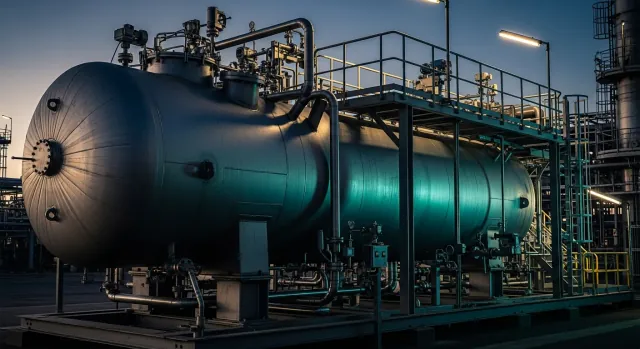

A coalescing oil-water separator that physically demulsifies and removes emulsified oil down to 0.1 µm — chemical-free, with greater than 95% oil removal — using super-oleophilic and hydrophobic coalescing fiber media and a four-in-one separation process integrating cyclonic centrifugal pre-separation, wetting coalescence, collision coalescence and intercept filtration.
The numbers behind the process.
What Is a Coalescing Oil-Water Separator?
Emulsified oil is the hardest fraction of oily wastewater to treat. API gravity separators and bare hydrocyclones handle free and dispersed oil efficiently — but stabilised emulsions, where fine oil droplets are protected by interfacial films, pass straight through. This residual fraction drives effluent non-compliance and downstream biological treatment failures.
A coalescing oil-water separator addresses this gap. High-surface-area oleophilic fiber media intercepts emulsified droplets through selective wetting, rupturing the stabilising film by physical contact. Captured droplets collide and merge — coalesce — into larger droplets that separate readily under gravity or centrifugal force. No chemical demulsifier is needed.
KHC is engineered from international coalescence theory, extensive CFD simulation, laboratory testing and proven field experience. Its coalescing media and internal components are protected by patents — delivering reliable, repeatable performance on the industry's most challenging emulsified wastewater streams.

Four separation mechanisms in one vessel: cyclonic pre-separation → wetting coalescence → collision coalescence → intercept filtration.
How Does a Coalescing Oil-Water Separator Work?
KHC integrates four separation mechanisms in sequence inside a single pressurised vessel. Each stage amplifies the previous one, enabling complete treatment of emulsified oil fractions that no single mechanism could handle alone.
Cyclonic centrifugal pre-separation
Wetting coalescence on super-oleophilic fiber
Collision coalescence & droplet growth
Intercept filtration & gravity separation

How Coalescing Fiber Media Removes Emulsified Oil
The super-oleophilic surface chemistry ensures fine oil droplets preferentially wet the fiber rather than remaining suspended in water. Once captured, proximity and flow energy cause droplets to collide and merge — growing from sub-micron emulsified droplets into millimetre-scale separated oil that rises rapidly.
Eight Reasons KHC Outperforms
Ultra-high-precision demulsification
Four-in-one separation
Super-oleophilic / hydrophobic fiber media
High dirt-holding & anti-fouling
Long modular cartridge life
High-quality recovered oil
Chemical-free & surfactant-tolerant
Patented internals / CFD-optimised flow
KHC vs Conventional Coalescing Separator
KHC is designed as a polishing / tertiary stage. A primary gravity separator or flotation unit (CDFU or CDOF) removes bulk and dispersed oil first, then KHC targets the residual sub-micron emulsified fraction before reinjection, discharge or reuse.
Where KHC Delivers

Gas field highly-emulsified condensate water
Gas-field condensate water often carries stabilised emulsions that resist conventional gravity separation and flotation. KHC delivers 0.1 µm precision demulsification and achieves water-in-recovered-oil below 1% — meeting the stringent quality targets for condensate reinjection or sale.
Oilfield solutions
Petrochemical / refinery emulsified oily wastewater & coking sour water
Refinery oily wastewater and coking sour water contain tightly emulsified oil fractions that survive API and DAF stages. KHC as a polishing step achieves oil removal exceeding 95%, reducing effluent oil to levels compatible with biological treatment or direct discharge.
Refinery solutions
Power-plant oily wastewater
Turbine-lube and transformer-oil contamination in power-plant drainage is frequently emulsified. KHC removes the residual emulsified fraction after gravity pre-separation, delivering reuse- or discharge-quality water without chemical treatment.
Power-plant solutions
Metallurgical solvent-extraction wastewater
Hydrometallurgical solvent-extraction circuits generate organic-laden aqueous raffinate with entrained extraction solvent. KHC's oleophilic media selectively captures the organic phase, recovering entrained solvent and meeting wastewater discharge standards.

Produced-water polishing downstream of CDFU / CDOF
KHC excels as a final coalescing stage in a multi-technology treatment train. After CDFU flotation removes bulk and dispersed oil, KHC targets the residual emulsified sub-micron fraction — closing the gap between flotation effluent and reinjection or discharge quality.
See CDFUProven Results
Representative KHC deployments on verified application streams. Figures are representative of stream type and operating range; specific project data available on request.
National Oil Company Refinery — Coking Sour Water
National Refinery — Coking Sour Water
Uzbekistan Refinery — Cooling Water Deoiling
Common Questions About Coalescing Oil-Water Separators
A coalescing oil-water separator is a vessel that uses high-surface-area media — typically fibrous or structured packing — to intercept fine and emulsified oil droplets suspended in water. The droplets wet onto the oleophilic media surface, collide and merge (coalesce) into larger droplets, and then separate rapidly by gravity or centrifugal force. KHC combines cyclonic pre-separation, wetting coalescence, collision coalescence and intercept filtration in a single vessel.
Emulsified oil droplets are stabilised by interfacial films that prevent them from merging under gravity alone. A coalescer's oleophilic fiber media captures these micro-droplets through selective wetting, rupturing the stabilising film by physical contact. Once captured, the droplets are forced into close proximity by the media geometry and the flow field, causing them to collide and merge (coalesce) into droplets large enough to separate by gravity or centrifugal force — no chemical demulsifier is needed.
Yes. KHC is designed specifically for emulsified oil removal. Its super-oleophilic and hydrophobic coalescing fiber media, combined with a patented CFD-optimised internal flow field, achieves a minimum separation particle size of 0.1 µm. This is 10–100× finer than conventional coalescers (1–10 µm) and enables effective treatment of nanoemulsions — such as gas-field condensate water and petrochemical sour water — that resist other physical separation methods.
A hydrocyclone uses centrifugal force to separate oil droplets large enough to experience a meaningful density difference from water — typically effective down to about 20–50 µm with free and dispersed oil. It cannot break or capture stabilised emulsions. A coalescer (such as KHC) intercepts and merges emulsified droplets as small as 0.1 µm using oleophilic media, making it the correct choice for the emulsified fraction. In practice, hydrocyclones and flotation units handle bulk and dispersed oil in the primary and secondary stages, while KHC provides the polishing / tertiary stage for emulsified oil.
Yes. KHC achieves demulsification purely through physical mechanisms: cyclonic centrifugal force, wetting on super-oleophilic fiber media, collision coalescence in the patented flow field, and intercept filtration. No chemical demulsifiers, coagulants or flocculants are added at any stage. This eliminates demulsifier purchasing, storage, dosing OPEX and the generation of chemically-contaminated oily sludge.
KHC's coalescing cartridges achieve 2–5× the service life of conventional coalescing cartridges. The fiber media has high dirt-holding capacity and strong anti-fouling characteristics, maintaining performance over extended operating periods. When replacement is required, the modular cartridge design enables fast, low-downtime in-situ swap without taking the entire vessel offline.
KHC excels wherever the oily wastewater contains a significant emulsified or sub-micron oil fraction that resists flotation or gravity separation. Proven applications include: gas-field highly-emulsified condensate water (0.1 µm precision demulsification, water-in-oil <1%); petrochemical / refinery emulsified oily wastewater and coking sour water (oil removal >95%); power-plant oily wastewater; metallurgical solvent-extraction wastewater; and produced-water polishing downstream of CDFU or CDOF flotation units. KHC operates best as a polishing / tertiary stage, with a primary gravity or flotation unit handling bulk and dispersed oil upstream.
Ready to Break the Emulsion — Physically?
Our engineers can size a KHC coalescing separator for your flow rate, inlet oil content and target effluent — and design a multi-stage train alongside CDFU or CDOF where the application requires it. Pilot tests available for challenging streams.